AngularJS - Experiencing new era
AngularJS is an open source web application framework. It was originally developed in 2009 by Misko Hevery and Adam Abrons. It is now maintained by Google.
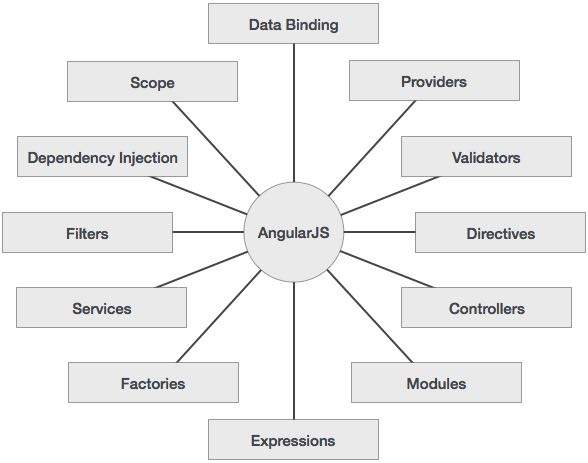
Features
- AngularJS is a powerful JavaScript based development framework to create RICH Internet Application(RIA).
- AngularJS provides developers options to write client side application (using JavaScript) in a clean MVC(Model View Controller) way.
- Application written in AngularJS is cross-browser compliant. AngularJS automatically handles JavaScript code suitable for each browser.
- AngularJS is open source, completely free, and used by thousands of developers around the world. It is licensed under the Apache License version 2.0.
Core Features
Following are most important core features of AngularJS −
- Data-binding − It is the automatic synchronisation of data between model and view components.
- Scope − These are objects that refer to the model. They act as a glue between controller and view.
- Controller − These are JavaScript functions that are bound to a particular scope.
- Services − AngularJS come with several built-in services for example $http to make a XMLHttpRequests. These are singleton objects which are instantiated only once in app.
- Filters − These select a subset of items from an array and returns a new array.
- Directives − Directives are markers on DOM elements (such as elements, attributes, css, and more). These can be used to create custom HTML tags that serve as new, custom widgets. AngularJS has built-in directives (ngBind, ngModel...)
- Templates − These are the rendered view with information from the controller and model. These can be a single file (like index.html) or multiple views in one page using "partials".
- Routing − It is concept of switching views.
- Model View Whatever − MVC is a design pattern for dividing an application into different parts (called Model, View and Controller), each with distinct responsibilities. AngularJS does not implement MVC in the traditional sense, but rather something closer to MVVM (Model-View-ViewModel). The Angular JS team refers it humorously as Model View Whatever.
- The other JS frameworks which have implemented MVC are :
- Deep Linking − Deep linking allows you to encode the state of application in the URL so that it can be bookmarked. The application can then be restored from the URL to the same state.
- Dependency Injection − AngularJS has a built-in dependency injection subsystem that helps the developer by making the application easier to develop, understand, and test.
Advantages of AngularJS
Single Page Application
- AngularJS provides capability to create Single Page Application in a very clean and maintainable way.
- A single-page application (SPA), is defined as a web application or web site that fits on a single web page with the goal of providing a more fluid user experience akin to a desktop application. In a SPA, either all necessary code – HTML, JavaScript, and CSS – is retrieved with a single page load or the appropriate resources are dynamically loaded and added to the page as necessary, usually in response to user actions. The page does not reload at any point in the process, nor does control transfer to another page, although modern web technologies (such as those included in HTML5) can provide the perception and navigability of separate logical pages in the application. Interaction with the single page application often involves dynamic communication with the web server behind the scenes.
Two Way Data-Binding
Think of your model as the single-source-of-truth for your application. Your model is where you go to to read or update anything in your application.Data-binding is probably the coolest and most useful feature in AngularJS. It will save you from writing a considerable amount of boilerplate code. A typical web application may contain up to 80% of its code base, dedicated to traversing, manipulating, and listening to the DOM. Data-binding makes this code disappear, so you can focus on your application.Think of your model as the single-source-of-truth for your application. Your model is where you go to to read or update anything in your application. The data-binding directives provide a projection of your model to the application view. This projection is seamless, and occurs without any effort from you.Traditionally, when the model changes, the developer is responsible for manually manipulating the DOM elements and attributes to reflect these changes. This is a two-way street. In one direction, the model changes drive change in DOM elements. In the other, DOM element changes necessitate changes in the model. This is further complicated by user interaction, since the developer is then responsible for interpreting the interactions, merging them into a model, and updating the view. This is a very manual and cumbersome process, which becomes difficult to control, as an application grows in size and complexity.There must be a better way! AngularJS' two-way data-binding handles the synchronization between the DOM and the model, and vice versa.Unit testing ready
- What description of Angular would be complete without talking about it’s unit testing readiness? The whole of Angular is linked together by Dependency Injection (DI). It’s what it uses to manage your controllers and scopes. Because all your controllers depend on DI to pass it information, Angular’s unit tests are able to usurp DI to perform unit testing by injecting mock data into your controller and measuring the output and behavior. In fact, Angular already has a mock HTTP provider to inject fake server responses into controllers.This beats the more traditional way of testing web apps by creating individual test pages that invoke one component and then interacting with it to see if it works.
Dependency Injection
AngularJS has a built-in dependency injection subsystem that helps the developer by making the application easier to develop, understand, and test.Dependency Injection (DI) allows you to ask for your dependencies, rather than having to go look for them or make them yourself. Think of it as a way of saying "Hey I need X', and the DI is responsible for creating and providing it for you.To gain access to core AngularJS services, it is simply a matter of adding that service as a parameter; AngularJS will detect that you need that service and provide an instance for you.You are also able to define your own custom services and make those available for injection as well.
Templates
It's important to realize that at no point does AngularJS manipulate the template as strings. It's all the browser DOM.
In AngularJS, a template is just plain-old-HTML. The HTML vocabulary is extended, to contain instructions on how the model should be projected into the view.
The HTML templates are parsed by the browser into the DOM. The DOM then becomes the input to the AngularJS compiler. AngularJS traverses the DOM template for rendering instructions, which are called directives. Collectively, the directives are responsible for setting up the data-binding for your application view.
It is important to realize that at no point does AngularJS manipulate the template as strings. The input to AngularJS is browser DOM and not an HTML string. The data-bindings are DOM transformations, not string concatenations or
innerHTML changes. Using the DOM as the input, rather than strings, is the biggest differentiation AngularJS has from its sibling frameworks. Using the DOM is what allows you to extend the directive vocabulary and build your own directives, or even abstract them into reusable components!
One of the greatest advantages to this approach is that it creates a tight workflow between designers and developers. Designers can mark up their HTML as they normally would, and then developers take the baton and hook in functionality, via bindings with very little effort.
Here is an example where I am using the
ng-repeat directive to loop over the images array and populate what is essentially an img template.
1
2
3
4
5
6
7
| <div ng-controller="AlbumCtrl"> <ul> <li ng-repeat="image in images"> <img ng-src="{{image.thumbnail}}" alt="{{image.description}}"> </li> </ul></div> |
It is also worth mentioning, as a side note, that AngularJS does not force you to learn a new syntax or extract your templates from your application.
MVC done right:
- AngularJS incorporates the basic principles behind the original MVC software design pattern into how it builds client-side web applications.The MVC or Model-View-Controller pattern means a lot of different things to different people. AngularJS does not implement MVC in the traditional sense, but rather something closer to MVVM (Model-View-ViewModel).
The Model
The model is simply the data in the application. The model is just plain old JavaScript objects. There is no need to inherit from framework classes, wrap it in proxy objects, or use special getter/setter methods to access it. The fact that we are dealing with vanilla JavaScript is a really nice feature, which cuts down on the application boilerplate.The ViewModel
A viewmodel is an object that provides specific data and methods to maintain specific views.The viewmodel is the$scopeobject that lives within the AngularJS application.$scopeis just a simple JavaScript object with a small API designed to detect and broadcast changes to its state.The Controller
The controller is responsible for setting initial state and augmenting$scopewith methods to control behavior. It is worth noting that the controller does not store state and does not interact with remote services.The View
The view is the HTML that exists after AngularJS has parsed and compiled the HTML to include rendered markup and bindings.This division creates a solid foundation to architect your application. The$scopehas a reference to the data, the controller defines behavior, and the view handles the layout and handing off interaction to thecontroller to respond accordingly.
Directives
Directives are my personal favorite feature of AngularJS. Have you ever wished that your browser would do new tricks for you? Well, now it can! This is one of my favorite parts of AngularJS. It is also probably the most challenging aspect of AngularJS.
Directives can be used to create custom HTML tags that serve as new, custom widgets. They can also be used to "decorate" elements with behavior and manipulate DOM attributes in interesting ways.
Here is a simple example of a directive that listens for an event and updates its
$scope, accordingly.
Then, you can use this custom directive, like so.
1
| <my-component ng-model="message"></my-component> |
Creating your application as a composition of discrete components makes it incredibly easy to add, update or delete functionality as needed.

Comments
Post a Comment